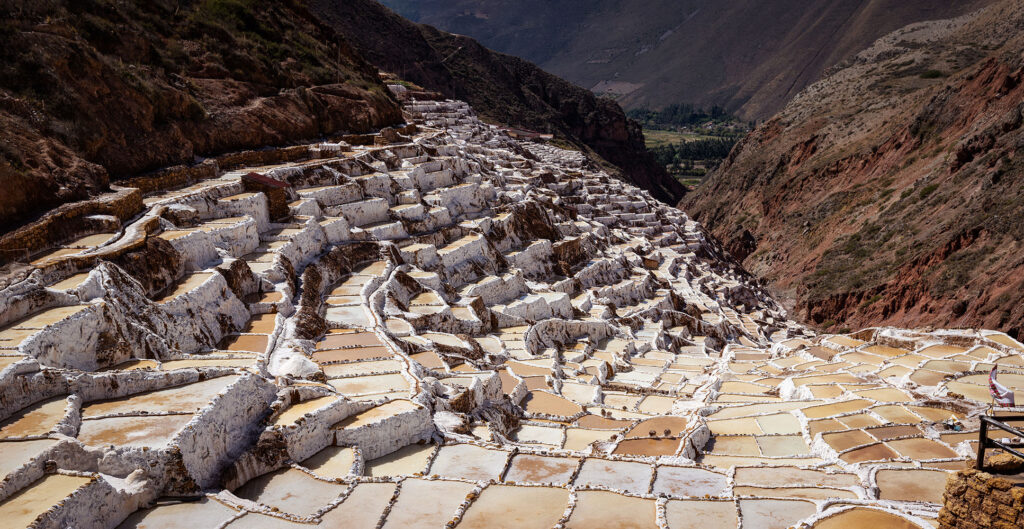
Thousands of small white, beige and ochre pools descend along the side of a mountain, like a giant mineral mosaic carved into the valley. From above, the landscape looks abstract. From closer up, you begin to understand that each pool is part of a living tradition passed down for generations.
These are the Maras Salt Mines, also known as the Salineras de Maras — one of the most striking places to visit near Cusco and the Sacred Valley.
Table of Contents
- What Are the Maras Salt Mines?
- Why Are the Maras Salt Mines So Special?
- A Landscape Born From an Ancient Ocean
- Where Are the Maras Salt Mines Located?
- How to Visit the Maras Salt Mines
- Can You Walk Inside the Salt Ponds?
- Best Time to Visit the Maras Salt Mines
- How Much Time Do You Need?
- What Makes Maras Different From Other Places in Peru?
- Is Maras Worth Visiting?
- Suggested Itinerary: A Beautiful Day Around Maras
- Plan Your Peru Journey With Majestic Andes
What Are the Maras Salt Mines?
The Maras Salt Mines are a network of salt evaporation ponds built into the mountainside near the town of Maras, in Peru’s Sacred Valley.
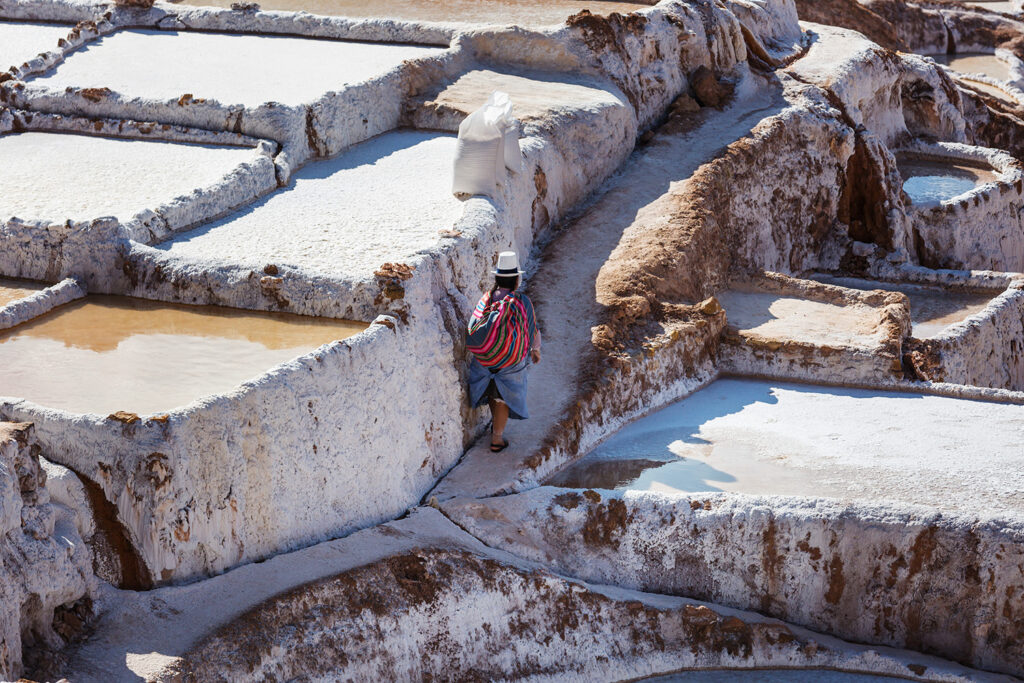
A naturally salty spring flows from the mountain. Its water is guided through a system of small channels into hundreds of shallow ponds. As the water evaporates under the Andean sun, salt crystals form on the surface and edges of the pools. Local families then collect, dry and prepare the salt.
The result is one of the most visually unusual landscapes in Peru: a patchwork of bright terraces surrounded by dry hills, fields, cliffs and mountain light.
The site has been used for salt production since before the Inca period, and families from the surrounding communities continue to work the ponds today.
Why Are the Maras Salt Mines So Special?
Many travelers arrive at Maras expecting a quick viewpoint. But the place becomes much more interesting when you understand what you are looking at.
This is not a ruin. It is not a reconstructed tourist attraction. It is a working cultural landscape.
Each pond belongs to local families from the communities around Maras and Pichingoto. The salt is harvested, carried, weighed and processed through practices that continue to connect local life with the land.
Majestic Andes insight: Maras is powerful because it is beautiful, but also alive. You are not only looking at a landscape. You are looking at a living Andean system.
A Landscape Born From an Ancient Ocean
One of the most surprising facts about the Maras Salt Mines is that their salt comes from geological history.
Millions of years ago, this region was influenced by ancient marine deposits. Today, groundwater passes through underground salt layers and emerges as a salty spring in the mountains near Maras. That water is then directed into the ponds, where evaporation leaves the salt behind.
In other words, when you look at Maras, you are seeing a connection between the Andes and an ancient sea.
That contrast is part of the magic: high mountains, dry earth, a hidden spring, and salt formed far from the ocean.
Where Are the Maras Salt Mines Located?
The Maras Salt Mines are located in the Sacred Valley of the Incas, near the town of Maras, in the Cusco region of Peru.
They are usually visited from:
- Cusco
- Urubamba
- Ollantaytambo
- Chinchero
- The Sacred Valley
The site is often combined with Moray, the famous circular Inca agricultural terraces located nearby.
From Cusco, the trip usually takes around half a day, depending on traffic, route and whether you include other stops. From Urubamba or the Sacred Valley, the visit is shorter and easier to integrate into a relaxed itinerary.
How to Visit the Maras Salt Mines
There are several ways to visit Maras, depending on your travel style.
1. Private Tour from Cusco or the Sacred Valley
This is the most comfortable option, especially if you want to understand the place rather than simply stop for photos.
A private guide can explain:
- How the salt ponds work
- Why salt mattered in the Andes
- The relationship between Maras and local communities
- How Maras fits into a larger Sacred Valley itinerary
- The difference between visiting from Cusco and staying in the valley
This is the best option for travelers who want a smooth, well-paced experience.
2. Maras + Moray Half-Day Tour
This is the classic combination.
Moray shows the agricultural intelligence of the Andes, with its circular terraces and microclimates. Maras shows another form of landscape knowledge: water, salt, evaporation and communal work.
Together, they make a very strong half-day experience in the Sacred Valley.
3. Visit from Urubamba or Ollantaytambo
If you are already staying in the Sacred Valley, Maras is much easier to include without rushing.
This is often the best way to experience the region. Instead of doing a long day trip from Cusco, you can visit Maras as part of a slower itinerary that also includes villages, viewpoints, local food and archaeological sites.
4. Independent Visit
It is possible to visit independently, but logistics can be less fluid if you do not have private transport. You may need a combination of public transport, taxis or local arrangements.
For travelers with limited time, a guided visit is usually more efficient.
Can You Walk Inside the Salt Ponds?
Today, visitors generally view the salt ponds from designated paths and viewpoints rather than walking directly among the pools. This helps protect the salt production area and reduce contamination.
This is important to respect. Maras is not just a scenic attraction; it is a working site where local families produce salt.
The experience is still very impressive from the viewpoints, especially with the right light.
Best Time to Visit the Maras Salt Mines
You can visit Maras all year round, but the experience changes with the seasons.
Dry Season: May to October
This is usually the best period for clearer views, stronger contrasts and better conditions for salt production.
During this time, the ponds often appear brighter, whiter and more defined.
Rainy Season: November to April
The landscape can be greener, and the surrounding hills may look more alive. However, the salt ponds may appear less bright depending on weather conditions.
Rain can also affect roads and visibility.
Best Time of Day
For photography, morning or late afternoon is often more beautiful than harsh midday light.
Late afternoon can be especially atmospheric, with softer light touching the terraces and the mountains around the valley.
How Much Time Do You Need?
For the Maras Salt Mines alone, you usually need around 45 minutes to 1 hour on site.
But for a more complete experience, it is better to think in terms of a half-day route.
Option 1: Half-Day from Cusco
Cusco → Moray → Maras Salt Mines → return to Cusco
Option 2: Sacred Valley Route
Chinchero → Moray → Maras → Urubamba or Ollantaytambo
Option 3: Slow Travel Version
Maras → Moray → local lunch → Sacred Valley village → overnight in Urubamba or Ollantaytambo
For Majestic Andes travelers, the third option is often the most rewarding. Maras is not a place to rush through if you want to feel the rhythm of the Sacred Valley.
Maras and Moray: Should You Visit Both?
Yes, absolutely.
Maras and Moray are very close to each other, but they offer two very different ways to understand the Andes.
Moray is about agriculture, altitude, temperature and experimentation. Its circular terraces are often interpreted as an Inca agricultural site where different levels may have created distinct microclimates.
Maras is about salt, water, geology and community work.
Together, they tell a deeper story: the Sacred Valley was not only beautiful — it was intelligently managed.
This is one of the reasons the Maras + Moray combination is so popular. It gives travelers a more complete view of Andean knowledge beyond the most famous sites.
What Makes Maras Different From Other Places in Peru?
Maras does not feel like Machu Picchu, Cusco or the classic Inca ruins.
Its power is quieter.
There are no monumental stone walls. No temples. No dramatic stairways.
Instead, Maras is made of repetition, patience and texture: salt, water, sun, clay, stone, hands, channels, ponds.
It is one of those places where the beauty comes from function. Every line has a purpose. Every pond belongs to a process. Every reflection is part of a working landscape.
That is why Maras photographs so well — but also why it deserves more than a quick photo.
Is Maras Worth Visiting?
Yes — especially if you enjoy landscapes with a story.
The Maras Salt Mines are not just “beautiful.” They are strange, graphic, ancient and alive. They show a side of Peru that is not only about ruins or postcard views, but about how people have worked with the land for centuries.
If your trip to Peru includes Cusco and the Sacred Valley, Maras is one of the easiest and most rewarding additions to your itinerary.
It is close enough to visit in half a day, but rich enough to leave a real impression.
Suggested Itinerary: A Beautiful Day Around Maras
Here is a simple way to include Maras in a Sacred Valley itinerary.
Morning
Leave Cusco or your hotel in the Sacred Valley.
Stop 1: Chinchero
Visit a traditional weaving center or the archaeological area, depending on your interests.
Stop 2: Moray
Explore the circular terraces and learn about Inca agricultural knowledge.
Stop 3: Maras Salt Mines
Walk to the viewpoints, observe the salt ponds and understand how the system works.
Lunch
Continue toward Urubamba for a relaxed lunch in the Sacred Valley.
Afternoon
Continue to Ollantaytambo, Pisac or your hotel, depending on your route.
This kind of day works especially well before or after visiting Machu Picchu, because it adds context to the Sacred Valley without making the itinerary too heavy.
Maras Salt Mines FAQ
Where are the Maras Salt Mines?
The Maras Salt Mines are located in the Sacred Valley of Peru, near the town of Maras, in the Cusco region.
Are the Maras Salt Mines still active?
Yes. The salt ponds are still used by local families from the surrounding communities. Salt is collected through evaporation, especially during the dry season.
What is the best season to visit Maras?
The dry season, from May to October, is often the best time for clearer views and brighter salt ponds.
Plan Your Peru Journey With Majestic Andes
Planning a journey through Cusco, the Sacred Valley and Machu Picchu?
At Majestic Andes, we design tailor-made Peru itineraries that connect the iconic sites with the quieter places that give them meaning — from Maras and Moray to Ollantaytambo, Pisac and beyond.
Let us help you create a Peru journey that feels smooth, personal and deeply connected to the places you visit.